
 Deutsch
 English
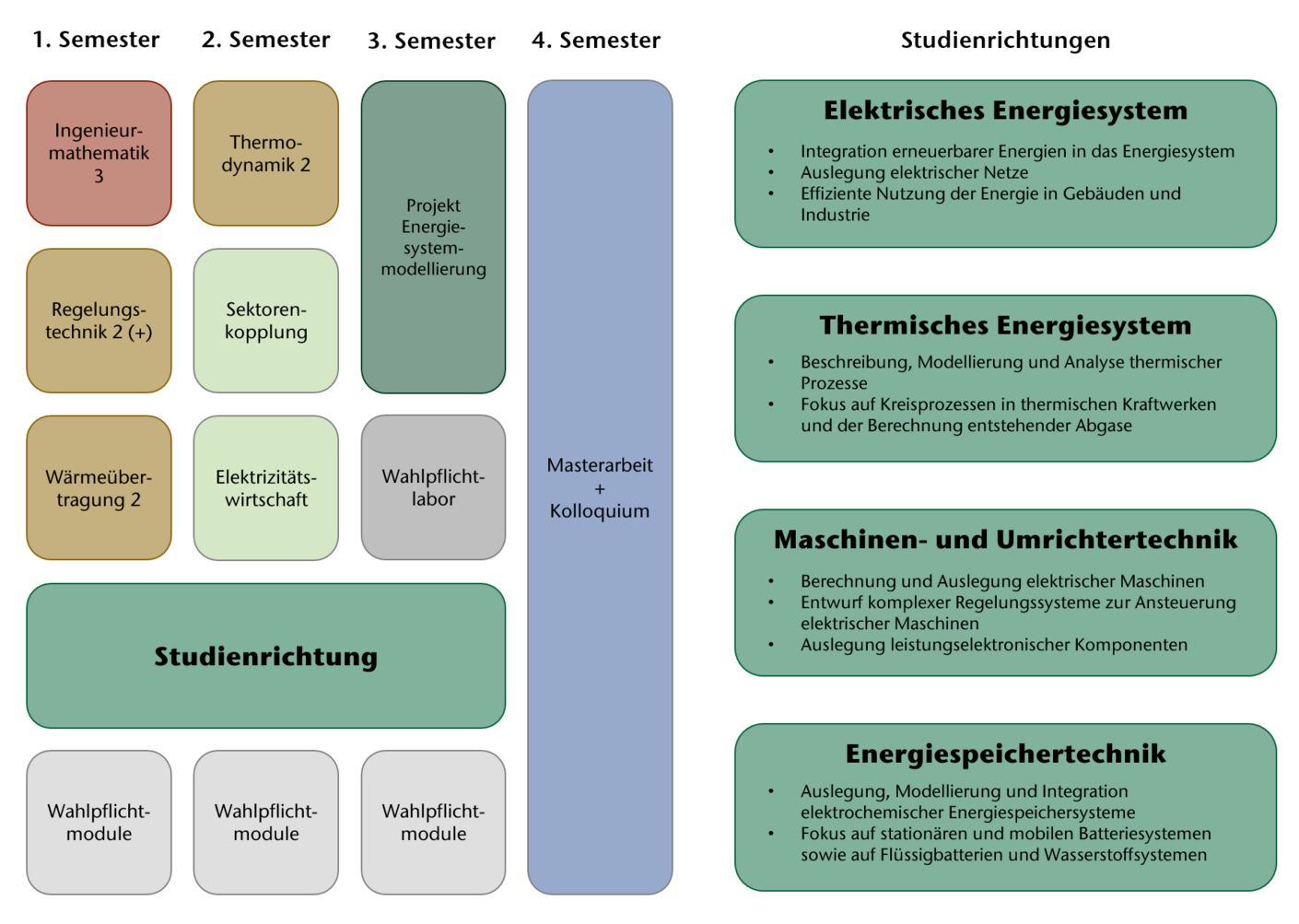
The Institute of Electrical Power Engineering and Energy Systems offers two consecutive degree courses, the Bachelor's degree course in Sustainable Energy Technology and Systems and the Master's degree course in Energy Systems Engineering, which will train you for the sustainable restructuring of the energy system to ensure an efficient and low-emission energy supply. While the Bachelor's course covers the entire breadth of energy technology, the Master's course allows you to specialize in a core topic of energy technology and systems. The aim of both courses is a comprehensive systems approach so that you can help shape the energy transition.
Focus on the big picture
The energy system is undergoing the most fundamental restructuring since it was established. Fluctuating renewable energies on the one hand and increasing electricity demand due to sector coupling on the other must be coupled efficiently and intelligently. The Energy Systems Engineering course prepares you for this by combining all the components of a sustainable energy system.
Building on engineering and energy technology fundamentals as well as an introduction to the energy industry and legal framework, you can specialize in the areas of electrical or thermal energy systems, machines and converter technology or energy storage technology. You can deepen, link and apply your knowledge in an extensive catalog of compulsory electives and a final project before your Master's thesis.
As part of the "Sustainable Energy Systems" research focus at Clausthal University of Technology, the degree course is closely linked to other degree courses and the TU's research centers.
Job profile and labor market
The energy transition affects us all, and the professional fields after graduating from the Energy Systems Engineering course are correspondingly diverse. In industry, your potential employers are not only the manufacturers of energy systems, but rather all companies in which energy is generated, converted or used. There are also project planners and operators of energy systems, grid operators and energy suppliers. In addition, you can mediate between the players involved in the energy transition and society in authorities, associations or politics.
The link between the degree course and the university's research centers gives you the opportunity to get involved in scientific work during your studies. Contact with other research institutes and industrial companies can be established as part of the project and Master's thesis. This makes a subsequent career in research possible, for example as part of a doctorate at Clausthal University of Technology.
News
Successful re-accreditation
The Bachelor's degree programme in Sustainable Energy Technology and Systems and the Master's degree programme in Energy Systems Engineering have been successfully reaccredited. Following extensive revision of the curricula, ASIIN awarded both degree programmes its seal of approval, confirming that the requirements of science and professional practice are met at a high level. At the same time, it documents that a secure framework for good teaching and successful learning is in place. The award of the seal is based on recognised learning outcome-oriented subject standards in accordance with the European Qualifications Framework and the "European Standards and Guidelines".
Contacts
Course coordinator
Prof. Dr.-Ing. Ines Hauer
IEE R806

Academic Advisor
Hannes Hanse, M.Sc.
IEE R801
Questions and consultation appointments
Bachelor Sustainable Energy Technology and Systems: ba.nets@tu-clausthal.de
Master Energy System Technology: ma.est@tu-clausthal.de