
 Deutsch
 English
Naomi
In Lower Saxony, the number of decentralized renewable energy generation systems in the low-voltage grid is growing, particularly photovoltaic systems with battery storage. Grid-forming control functions in the inverters will increasingly enable these systems to continue operating as isolated grids after being disconnected from the main grid. While this can enhance supply reliability, it can also significantly impair or render conventional islanded-grid detection methods ineffective. Therefore, innovative methods compatible with grid-forming inverters are required to enable a safe decision between shutdown and continued operation. At the same time, faults in the low-voltage grid must be reliably detected and accounted for, as continued operation could prevent fault clearance and endanger operational safety and personal safety. For safe island grid operation, control strategies are also necessary to ensure stable parallel operation of many electrically adjacent grid-forming inverters. These controls must prevent overloads of individual inverters, undesirable fluctuations in active and reactive power, as well as issues related to converter-driven stability and resonance stability, in both grid-connected and islanded grid operation.
Research objectives in the Naomi subproject
Innovative islanding detection
The subproject at Clausthal University of Technology is developing a passive, real-time method for reliably and quickly distinguishing between interconnected and isolated grid operation, particularly when grid-forming inverters (GFM) are used. It is designed not to compromise power quality and to leave the decision regarding continued operation or shutdown to a downstream logic controller. The approach is based on the hypothesis that the frequency noise behavior in interconnected and islanded grids differs statistically and can be evaluated using high-resolution voltage measurements. To this end, existing detection methods are being investigated, a simulation model is being developed that accounts for relevant disturbances and grid events, and frequency demodulation methods and suitable evaluation algorithms are being developed. Validation is performed using collected measurement data and through experiments in the IEE’s distribution network laboratory. In addition, various GFM control strategies are being investigated with regard to their stability in grid-connected and islanded grid operation. The goal is to develop a standards-compliant prototype that is compatible with various inverter control strategies and can be integrated into existing inverters as well as used as a standalone measurement and analysis unit. Naomi is thus intended to support the broader deployment of grid-forming inverters and, by enabling targeted island mode operation, to increase supply reliability while potentially reducing power outages and the need for UPS systems.
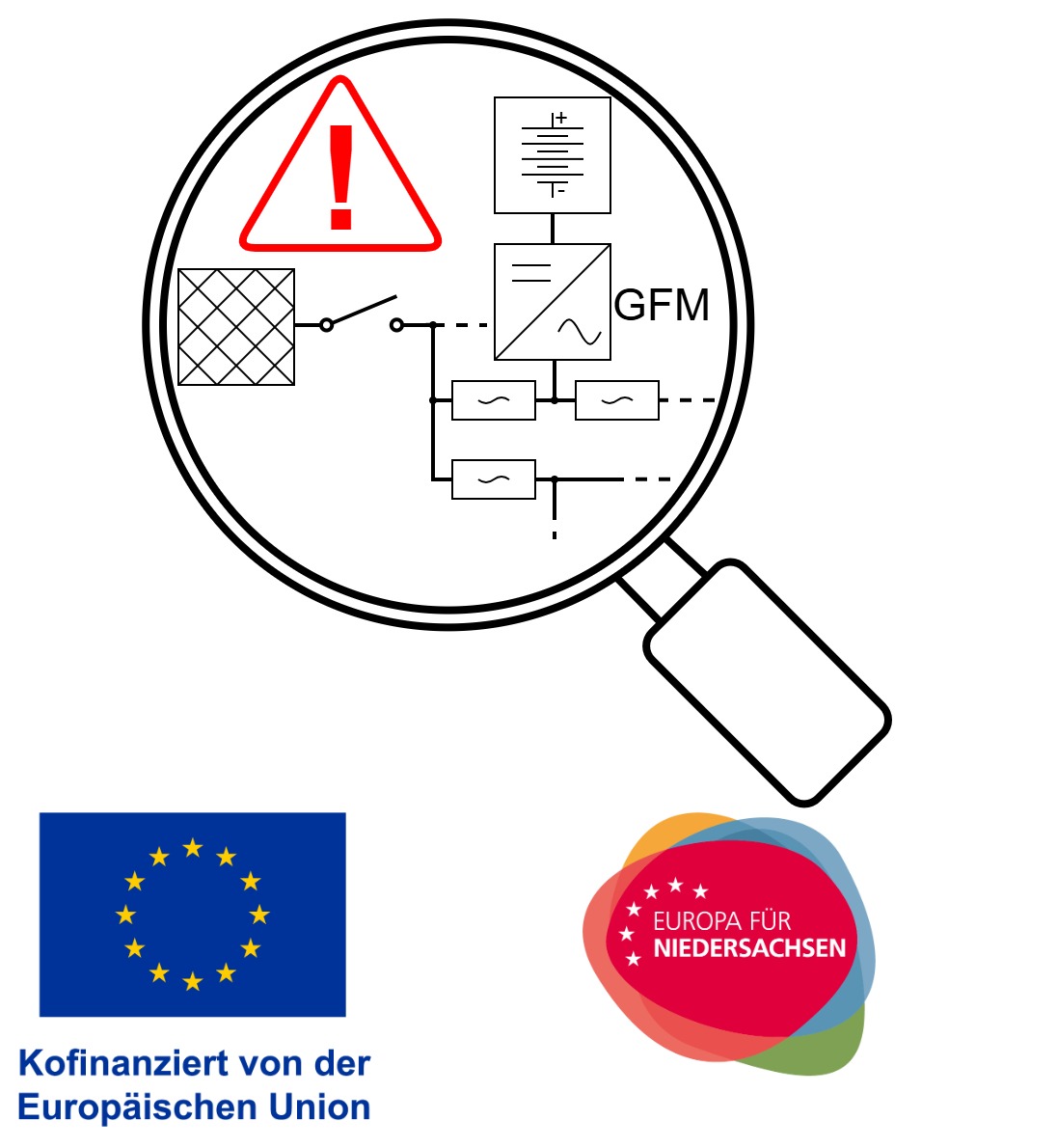
Grid Security and Stability in the Context of Grid-Forming Converters
Funded:
Europäischen Fonds für Regionale Entwicklung (EFRE) im Programmgebiet SER sowie durch niedersächsische Landesmittel (MWK)
Duration:
01.09.2026 – 28.02.2029
Contact
Editor:
Dipl.-Ing. Philip Gilliam [Contact]
Leader:
Prof. Dr.-Ing. Ines Hauer [Contact]
Research Advisor:
Dr.-Ing. Dirk Turschner [Contact]
Partners:
Leibniz Universität Hannover Institut für Elektrische Energiesysteme
EWE Netz GmbH
Harz Energie Netz GmbH
Stadtwerke Clausthal-Zellerfeld
Energiewerkstatt Gesellschaft für rationelle Energie mbH & Co. KG
Power Innovation Stromversorgungstechnik GmbH
Windenergie Hattorfer Berg GmbH & Co. KG
Jade Hochschule Wilhelmshaven/Oldenburg/Elsfleth